
Notes on productivity, performance, and premature delegation
There’s a particular kind of relief that comes with automating something. Your brain switches off, you take the passenger seat, and you let AI take the lead.
As a company, we’ve seen genuine pay-off from platforms like Copilot. But it’s still important to know when to draw the line.
I’ve read plenty of blogs that position AI as the thing eroding thinking at work. As if the moment we introduce a tool, judgment disappears with it. That’s a very convenient simplification, and another instance of humans blaming the tool for behaviour we were already prone to.
This isn’t really a computer problem. It’s a human one. We’ve always had a tendency to put our heads down, push systems to their absolute limits, and only realise we’ve crossed into a moral grey area once we’re already there. AI just makes that tendency more visible and a lot faster.
To be clear, there is a place for AI at work. Ask anyone at IComm and you’ll get a different answer for how they use Copilot. Writing, summarising, structuring, sense-checking, automating the boring bits — things that actually save time and mental energy.
The question isn’t whether we should use these tools. It’s how and when. And more specifically, which part of the work we’re handing over.
The problem is that the line between automation and avoidance is thinner than we think. “Efficiency” can slip from removing unnecessary effort into removing thinking altogether.
This is what happens when automation stops being a tool and becomes the goal. When we outsource thinking before we’ve even done any ourselves.
Some aspects of work are slow for a reason. Thinking through a problem properly, sitting with uncertainty or making sense of messy information before it turns into something usable.
Those slower moments are often where judgment is formed, not applied.
In my current role, brainstorming, writing, planning, and scribbling are all manual tasks that require my full attention. And even though my attention span has absolutely suffered at the hands of TikTok, I still have to remind myself that these steps — slow and occasionally uncomfortable — are the foundations that truly deserve time.
But in a world obsessed with output, those moments can feel unproductive. They don’t generate neat answers or instant results. So, it’s tempting to skip them. Tools promise speed and certainty. They offer answers when we’re still forming questions. And it’s very hard to sit with a question when an answer is immediately available. They fill blank pages before we’ve worked out what we’re trying to say. Thus, making it easy to confuse movement with progress or output with understanding.
There’s a clip doing the rounds from a recent Jacob Elordi interview where the actor states, half-jokingly, “bring back shame.” It’s funny not because shame is the goal, but because it points to something we’ve lost — the willingness to sit in unfinished work, visible effort, and the discomfort of not knowing yet. Which, inconveniently, is where critical and creative thinking actually happen.
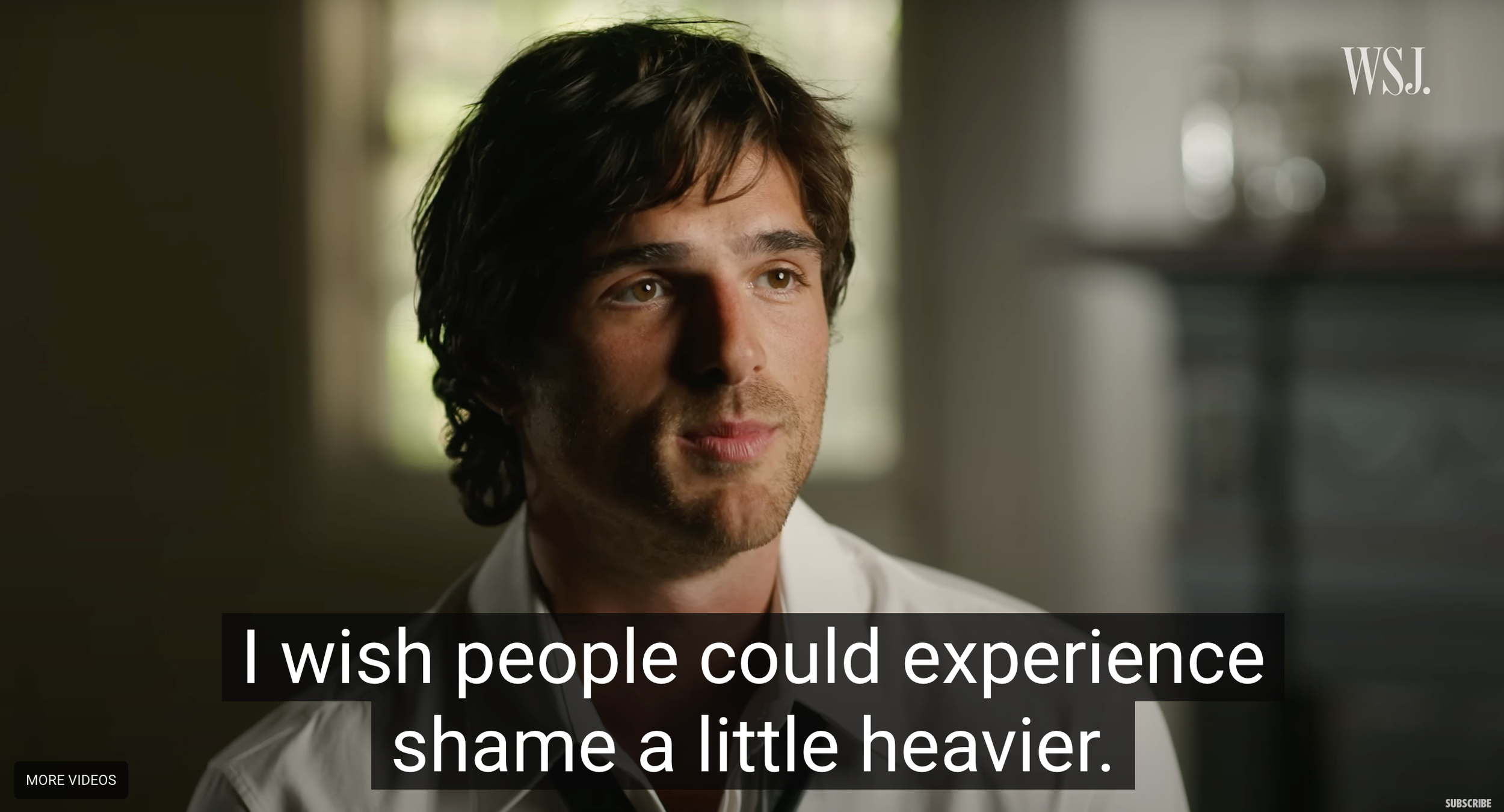
In a late-2025 interview with WSJ Magazine, actor Jacob Elordi referenced the idea of bringing back the “art of shame.”
At work, that half-formed state doesn’t just feel uncomfortable. It feels embarrassing — almost like confirmation that you’re not good enough.
Being mid-thought. Not knowing yet. Having to actually do the work and use your brain —when you know output could be automated with the click of a button.
Is that shaped by the environment we work in? Probably. But it’s still a choice. And it’s a choice that keeps being made.
You hand it over. Before you’ve wrestled with it. Before you’ve done the part that costs something.
That’s not a technology problem.
It’s a patience and tenacity problem.
This is why the phrase “AI slop” gets thrown around so easily and why it’s so misplaced. What people are reacting to isn’t a failure of the tool. It’s the absence of effort before the tool was ever introduced.
I know this because I feel it when I write. The pieces that are worth anything only come after sitting in an uncomfortable state — the part that feels like sitting in a pool of my own sweat. If that image made you uncomfortable, you’ve just proved my point.
AI makes it easier to avoid that stage because it gives you an out.
And you take it.
That discomfort you’re trying to eliminate?
That’s the part you should never automate.
Shame and all.
